
NHL Postseason & Playoff Betting
 Available in US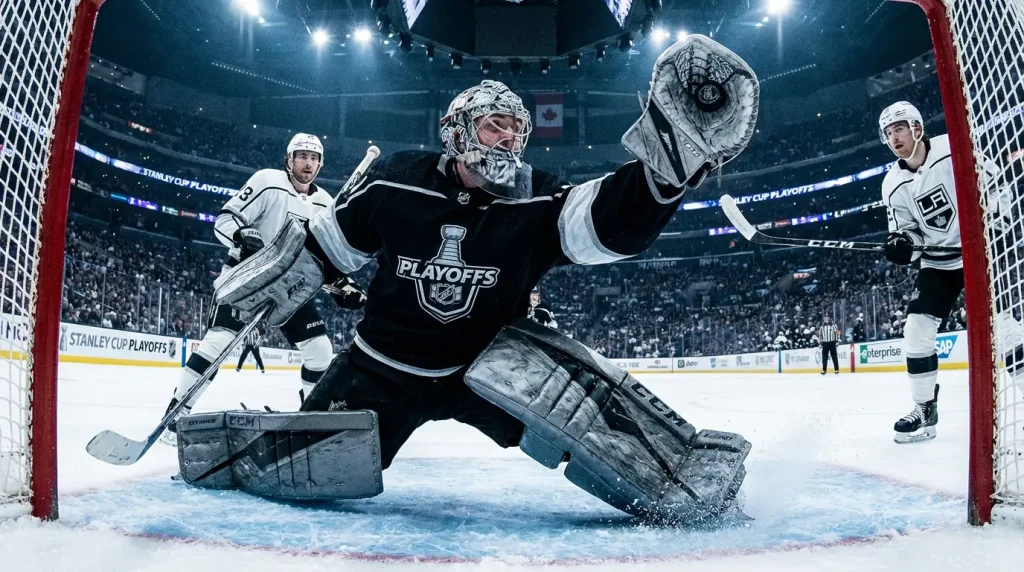
The NHL playoffs are a different sport. That is not a cliche — it is a statistical reality that bettors ignore at their own expense. Scoring drops. Checking intensifies. Goaltenders who were average during the regular season transform into impenetrable walls. Referees swallow their whistles, power play opportunities decrease, and games that would have ended 5-3 in January end 2-1 in April. Every analytical framework you built during the regular season needs recalibration the moment the postseason bracket is set, and the bettors who fail to make that adjustment are the ones funding the payouts for those who do.
The Stanley Cup Playoffs consist of four best-of-seven rounds, starting with sixteen teams and ending with one hoisting the Cup. The format rewards consistency, depth, and goaltending more than any other structure in professional sports. A hot team can steal a game. It cannot steal a seven-game series. The cream rises, but the cream in playoff hockey looks different than the cream in the regular season, and understanding that difference is the foundation of profitable postseason wagering.
Postseason Scoring Trends and Totals
Regular-season NHL games average roughly 6.0 to 6.4 total goals. Playoff games historically average closer to 5.2 to 5.6. That decline of roughly half a goal to a full goal per game is not random noise. It reflects a structural shift in how the game is played when elimination is on the line.
Defensive intensity increases dramatically. Teams play tighter systems, collapse around the net more aggressively, and sacrifice their bodies to block shots at a much higher rate. Shot-blocking attempts per game rise by 15-20% in the playoffs compared to the regular season, which directly reduces the number of pucks reaching the goaltender and suppresses overall goal production.
Goaltenders perform better. The average save percentage in the playoffs has historically exceeded the regular-season average by a small but consistent margin. Part of this is selection bias — the teams that make the playoffs tend to have better goaltending — but part of it is genuine performance elevation. Goaltenders raise their focus and consistency when every save matters, and the reduced fatigue from playing every other day rather than every day helps maintain physical sharpness throughout a series.
For bettors, the scoring decline means totals that were appropriate during the regular season are systematically too high for the playoffs. Sportsbooks adjust their postseason totals downward, but the adjustment is not always sufficient, particularly in the first round when the market is still transitioning from regular-season pricing. Under bets in early playoff rounds have historically shown a slight edge, and the value is strongest in series featuring two defensively oriented teams with elite goaltending.
Reduced Special Teams Opportunities
The most impactful change from regular season to playoffs is the decline in power play opportunities. Referees call fewer penalties in the postseason, which is a documented and widely acknowledged trend in NHL officiating. The average number of power play opportunities per team per game drops by roughly 0.5 to 1.0 in the playoffs compared to the regular season.
This reduction has cascading effects on betting markets. Teams whose regular-season success was heavily dependent on the power play see their offensive output decline disproportionately. A team that scored 25% of its regular-season goals on the power play is losing a quarter of its offensive engine when penalty calls decrease. Conversely, teams with strong five-on-five play and less reliance on special teams maintain their production more consistently in the postseason.
For moneyline betting, this means regular-season standings can be misleading predictors of playoff success. A team that finished fifth in the league powered by a dominant power play may be less formidable in the playoffs than a team that finished eighth but generated more of its offense at even strength. Evaluating each team’s five-on-five goal differential, independent of special teams, is a more accurate predictor of playoff performance than overall goal differential.
Series Pricing and Game-by-Game Handicapping
Playoff betting offers two distinct market types: series prices and individual game lines. Series prices ask you to pick which team will win the best-of-seven series, with odds that reflect the market’s assessment of each team’s overall probability of advancing. Individual game lines are standard moneylines, puck lines, and totals for each specific contest within the series.
Series prices are set before the first game and adjust after each game based on the result. A team that was -160 to win the series before Game 1 might move to -250 after winning the opener, because historical data shows that the team winning Game 1 of a playoff series wins the series approximately 65-70% of the time. That adjustment creates opportunities for bettors who disagree with the market’s interpretation of a single game’s impact on the series outcome.
Game-by-game handicapping within a series is where playoff betting gets genuinely interesting. Unlike the regular season where each game is an isolated event between teams that might meet only twice a year, a playoff series is a sequence of games between the same two opponents with evolving tactical adjustments. The team that lost Game 1 has video of what went wrong and two days to adjust. The team that won Game 1 must anticipate those adjustments and counter them. This chess match creates information asymmetries that sharp bettors can exploit.
The value in game-by-game playoff betting often appears in Games 3 and 4, when the series shifts to the other team’s arena. Home ice advantage in the playoffs is slightly larger than in the regular season, and the emotional lift of returning home after two road games can produce a performance spike that the market underestimates. Teams that are down 0-2 coming home for Game 3 win that game at a higher rate than their series deficit would suggest, because the desperation of facing elimination combines with home crowd energy to produce peak effort.
Goaltending Becomes Everything
If goaltending is the most important variable in regular-season betting, it becomes the dominant variable in the playoffs. Playoff series are frequently decided by which goaltender performs closer to his peak over four to seven games. A goaltender who posts a .935 save percentage across a series is almost guaranteeing his team advances, regardless of how the skaters perform in front of him.
The challenge for bettors is that goaltending performance in short playoff series is difficult to predict. A goaltender who was mediocre during the regular season can suddenly become dominant in the postseason, and a Vezina-caliber starter can have a disastrous series. The variance in goaltending performance over a four-to-seven game sample is enormous, which means playoff betting inherently carries more uncertainty than regular-season betting.
What you can project with more confidence is the floor rather than the ceiling. A goaltender with a strong track record of playoff performance, consistently high GSAx numbers, and demonstrated ability to perform under pressure is a safer bet to maintain his level than a goaltender making his first deep playoff run. Experience does not guarantee excellence, but it reduces the probability of a catastrophic collapse, and in a market where the difference between teams is often slim, that reduced downside risk has meaningful value.
Adjusting Your Approach for the Postseason
The practical adjustments for playoff betting start with recalibrating your models. If you use Corsi, expected goals, or other possession metrics, shift your inputs to focus on five-on-five data and reduce the weight you give to special teams numbers. The playoff game is primarily an even-strength contest, and your projections should reflect that.
Lower your expected totals. If your regular-season model projects a game at 6.2 total goals, apply a playoff discount of 0.5 to 0.8 goals, depending on the series matchup. Series between two defensive teams with elite goaltending warrant a larger discount than series between two high-powered offenses. The sportsbook will also adjust, but your independent projection gives you a basis for evaluating whether their adjustment is sufficient.
Increase the weight you give to goaltending in your moneyline projections. During the regular season, goaltending might account for 25-30% of your handicapping model. In the playoffs, that number should rise to 35-40% because the goaltender’s influence on the outcome is magnified by the lower-scoring, tighter-checking environment.
Track in-series adjustments. After each game, note which tactical changes each team made and how they affected possession and scoring chance quality. A team that was dominated in Game 1 but implemented a neutral zone trap in Game 2 that reduced the opponent’s high-danger chances by 30% is making a meaningful adjustment that the series price may not fully reflect.
The Postseason Rewards the Patient
Playoff betting is not about volume. The regular season offers 1,300-plus games and allows you to grind through high-volume strategies. The playoffs offer roughly 85 games total, spread across two months, and each one carries enough variance to sink a reckless bankroll. The successful playoff bettor is selective, patient, and willing to pass on games where the edge is marginal.
The best playoff bettors treat each series as a contained project. They build a thesis before Game 1 — which team has the five-on-five advantage, the goaltending advantage, the coaching advantage — and then update that thesis after each game based on observed evidence. They do not chase losses after a bad Game 1 result, and they do not over-leverage after a good one. The playoffs are a marathon of seven-game sprints, and the bankroll that survives the first round intact is the one positioned to profit from the chaos that inevitably unfolds as the bracket narrows toward the Cup.
