
Stanley Cup Futures Betting
 Available in US
Futures betting represents one of the most potentially lucrative corners of sports wagering, and the Stanley Cup market sits at the apex of hockey betting opportunities. Unlike single-game bets where you might win $100 on a successful wager, futures bets on long-shot teams to win the championship can return thousands of dollars on relatively modest stakes. The Vegas Golden Knights reached the Stanley Cup Final in their inaugural 2017-18 season at opening odds of 500-to-1, meaning a $50 bet on them to win the Cup would have returned $25,000 had they defeated the Washington Capitals. Those stories fuel the dreams of every futures bettor.
The appeal of Stanley Cup futures extends beyond the potential payouts. These bets keep you invested in the entire NHL season rather than caring only about tonight’s game. When you have a ticket on the Colorado Avalanche to win it all, every regular season game matters because you are watching your investment appreciate or depreciate in real time. The emotional engagement transforms casual viewing into something more visceral, which is part of what makes futures betting so popular despite the long wait for resolution.
This guide covers everything you need to know about betting on the Stanley Cup in 2026. We will examine how futures odds work, when to place your bets for maximum value, how to analyze contenders, and the various strategies that sharp bettors employ to find edge in championship markets. Whether you are looking to back a favorite at shorter odds or take a shot on an underdog with explosive potential, understanding the nuances of futures betting dramatically improves your chances of walking away a winner.
Locking in your championship predictions early is a core component of successful NHL futures betting, allowing you to secure the best possible value.
Comparing Stanley Cup Finals Odds
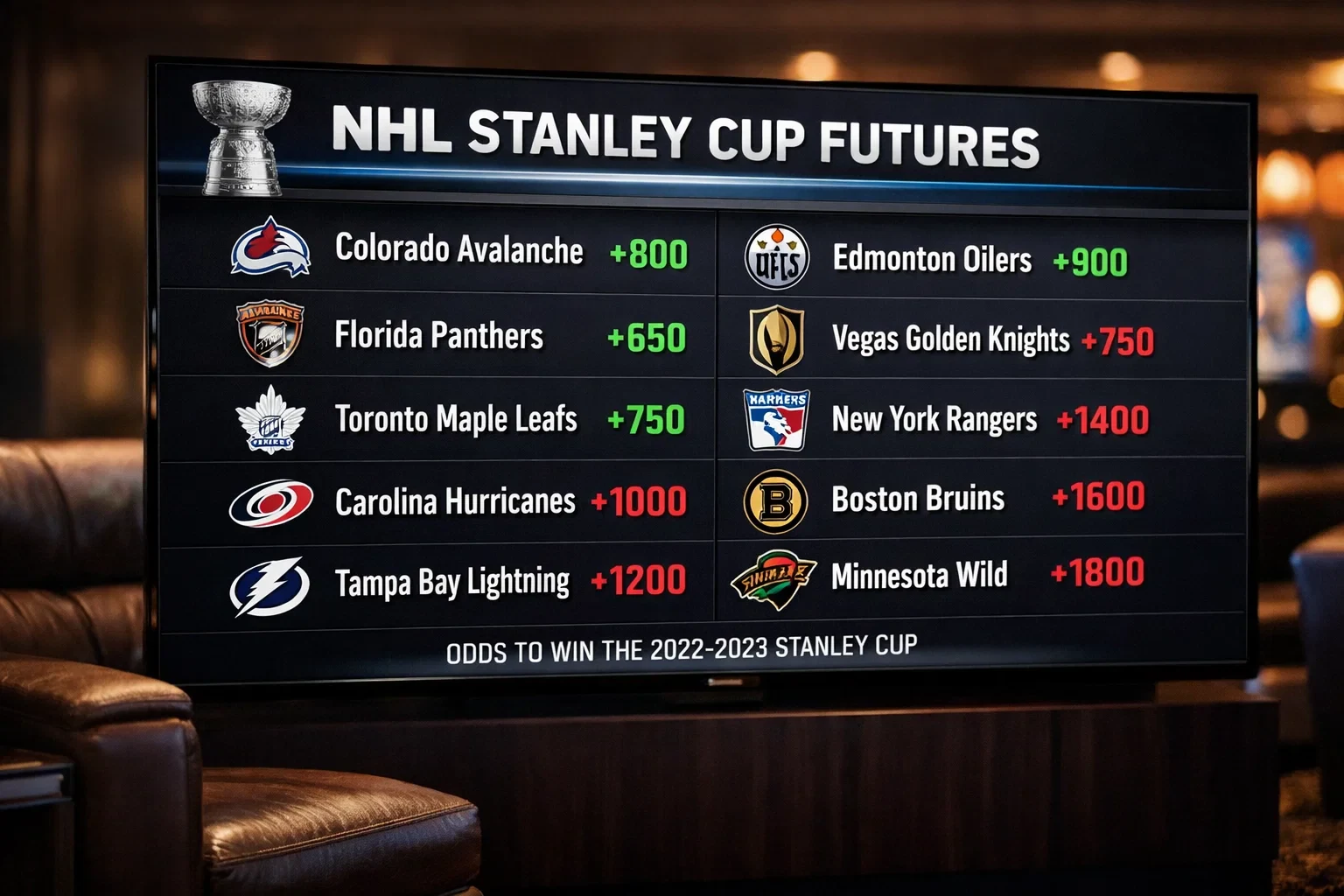
Stanley Cup futures odds represent the sportsbook’s assessment of each team’s probability of winning the championship. Unlike game lines where odds are set primarily by expected outcomes, futures odds incorporate significant uncertainty over a six-month horizon and build in extra margin for the book’s protection. Learning to read these odds and convert them to implied probabilities is the foundation of intelligent futures betting.
Futures odds are typically displayed in American format, showing either plus or minus numbers. A team listed at +800 means a $100 bet returns $800 in profit plus your original stake if that team wins the Cup. A team listed at +150 means $100 returns $150 in profit. When you see a heavy favorite at +400 and a long shot at +8000, the difference reflects both perceived championship probability and the margin sportsbooks build into long-shot bets. Converting +800 to implied probability involves the formula 100 divided by (800 plus 100), yielding approximately 11.1%. The sportsbook believes that team has roughly an 11% chance of winning, though the actual probability may differ from what the market implies.
Preseason odds versus in-season odds behave differently and require distinct approaches. Preseason odds are set months before games begin, based on roster projections, offseason moves, and historical performance. These lines contain maximum uncertainty because injuries, breakout players, and chemistry issues have not yet materialized. In-season odds adjust based on actual results, incorporating information that was unknowable in October. A team that started at +2000 might drop to +800 after a strong first half, while a preseason favorite at +600 might drift to +1500 after injuries to key players.
The mechanism of odds movement throughout the season reflects both genuine probability changes and betting action. When sharp bettors load up on a team, sportsbooks shorten the odds to reduce their liability. When a team loses its starting goaltender to injury, the probability of winning the Cup genuinely decreases, and odds lengthen accordingly. Understanding whether a line move reflects new information or merely money flow helps bettors determine if value still exists. A team that drifts from +1200 to +1500 because of one bad month might offer better value at the longer price if the underlying talent remains intact.
Implied probability calculations become essential when comparing opportunities across teams. If you believe the Florida Panthers have a 15% chance of winning the Stanley Cup, any price longer than approximately +567 offers positive expected value. Converting your probability assessments to break-even odds and comparing them to available prices systematizes the process of finding value rather than betting on hunches about which team feels like a winner.
Best Time to Bet on the Stanley Cup

Timing dramatically affects the value available in Stanley Cup futures markets. Betting at the wrong moment locks in unfavorable prices, while betting at optimal windows can provide substantial edges that compound the already attractive payouts of futures wagers.
Preseason betting offers the highest potential returns but also the greatest uncertainty. Before a single puck drops, sportsbooks post odds that reflect offseason projections rather than demonstrated performance. Teams that made significant acquisitions might be overvalued because the market assumes those players will integrate seamlessly. Teams that lost key pieces might be undervalued if the market overweights past success without accounting for roster changes. The best preseason value often exists on teams with stable cores that the market has grown bored with, or on young teams whose trajectory the market underestimates.
Mid-season adjustments create value opportunities as the market overreacts to recent results. A legitimate contender that loses five straight games in December will see their odds lengthen, but if the underlying metrics suggest the losing streak was bad luck rather than fundamental collapse, buying at the longer price offers value. Similarly, a mediocre team that strings together wins against weak opponents might see their odds shorten beyond what their true probability warrants. The middle of the season, particularly around the sixty-game mark, often provides the clearest picture of team quality while still offering prices that have not fully adjusted to new information.
The NHL trade deadline in early March creates dramatic shifts in futures odds. Contenders that acquire star players see their odds shorten immediately, sometimes by hundreds of points. Sellers who trade away key assets see their odds lengthen to reflect reduced rosters. The days immediately before and after the deadline offer both opportunity and risk. If you anticipate a team will make a significant addition, buying before the deadline captures value that evaporates once the trade is announced. If you believe a team is already overvalued and will disappoint in the playoffs regardless of deadline moves, holding off until their odds lengthen post-deadline makes sense.
Playoff betting represents the final window for futures wagers, with dramatically shorter odds but substantially reduced uncertainty. A team that has survived the first round and looks dominant might still be available at +300 or +400 to win the Cup, prices that offer meaningful returns for a three-round commitment. The tradeoff is that you have missed the preseason and regular season value, but you have also avoided the risk of your team missing the playoffs entirely or losing in the first round.
Types of NHL Futures Bets
Stanley Cup winner bets represent the flagship futures market, but sportsbooks offer numerous other long-term wagers that provide both standalone value and hedging opportunities for Cup bets.
The Stanley Cup winner market is straightforward: pick the team that will win the championship, collect if they do. Every team has a price, from the favorite at perhaps +500 to the bottom-dweller at +15000. The market is typically deep enough that finding a price you like on a team you believe in is possible, though the very longest shots carry such high house edge that they are rarely good bets despite their appeal. Most sharp futures bettors focus on teams in the +600 to +2500 range, where the balance between probability and payout is most favorable.
Conference winner bets offer a middle ground between team-specific futures and single-game wagers. Picking the Eastern or Western Conference winner means your team only needs to win three rounds rather than four, reducing variance while still providing meaningful payouts. Conference winner bets also enable hedging strategies: if you have a Stanley Cup ticket on an Eastern Conference team and they make the final, betting the Western Conference representative to win the Cup creates a guaranteed profit regardless of the series outcome.
Division winner markets provide even more granular futures opportunities. With four divisions of eight teams each, the probability of any single team winning their division is much higher than winning the entire Cup, meaning shorter odds but more frequent wins. Division bets resolve earlier than Cup bets, with winners determined by late April rather than mid-June. Some bettors use division winners as bankroll-building bets that fund deeper Cup speculation on other teams.
Regular season points totals offer over/under betting on how many standings points a team will accumulate across the 82-game schedule. A typical line might set the total at 98.5 points, with bettors wagering whether the team exceeds or falls short of that mark. These bets resolve before playoffs begin and are based entirely on regular season performance, making them immune to playoff variance. Teams with high win totals expectations paired with uncertain playoff prospects sometimes offer value on the over, while teams expected to coast through the regular season while resting for playoffs might offer under value.
Individual award futures including the Hart Trophy for league MVP, the Vezina Trophy for best goaltender, the Calder Trophy for best rookie, and the Norris Trophy for best defenseman provide another layer of futures betting. These markets are often less efficient than team-based futures because they receive less betting action, creating opportunities for bettors who closely follow individual player performance. A goaltender off to a hot start might offer value for the Vezina before the market fully adjusts, while a rookie putting up points on a non-contending team might be underpriced for the Calder.
Analyzing Stanley Cup Contenders
Identifying teams with legitimate championship probability requires looking beyond regular season standings to the specific factors that predict playoff success.
Goaltending importance in the playoffs cannot be overstated. The Stanley Cup Playoffs are a different sport than the regular season, with tighter checking, fewer power plays, and vastly elevated stakes. Teams with elite goaltending consistently outperform their regular season expectations in the postseason, while teams that succeeded on offense during the year often find that scoring dries up against determined playoff defenses. When evaluating futures bets, weighting goaltending more heavily than regular season goal differential improves your probability estimates. A team with a Vezina-caliber starter and competent backup has championship upside that a team with league-average goaltending lacks, regardless of regular season point totals.
Roster depth and injury resistance separate Cup winners from early-round exits. The playoffs span two months, with teams potentially playing 28 games in approximately 60 days. Injuries are inevitable, and teams that can absorb the loss of key players without collapsing maintain championship viability. Evaluating a team’s depth beyond their top line and first pairing identifies which contenders can survive the attrition of playoff hockey. Teams with multiple players capable of scoring in pressure moments, rather than relying entirely on one or two superstars, historically perform better when facing elimination.
Historical championship team profiles reveal patterns that inform futures betting. Recent Cup winners have typically combined elite goaltending with at least one dominant line, strong special teams in both directions, and experienced leadership that has tasted playoff failure before breaking through. Teams winning their first championship often had multiple years of playoff disappointment that built the resilience and knowledge necessary to survive four rounds. First-time contenders with young rosters sometimes offer preseason value, but their probability of actually winning it all is lower than their odds suggest because they have not yet learned how to win in June.
Playoff experience matters more than regular season dominance. A team that finishes second in their division but has extensive postseason experience often represents better value than the division winner making their first playoff appearance. The presidents’ trophy winner, given to the team with the best regular season record, has historically underperformed in the playoffs relative to their top-seed status. Betting on the best regular season team because they were the best regular season team ignores the reality that playoff hockey rewards different skills than the 82-game grind.
Finding Value in Stanley Cup Markets
Value in futures betting exists when your probability estimate exceeds the implied probability of the available odds. Finding that value requires combining analytical assessment with market awareness.
Long shot strategies appeal to bettors seeking life-changing payouts from small stakes. The mathematical reality is that most long shots are overpriced rather than underpriced, meaning the house edge on +5000 and longer odds is typically much higher than on favorites. However, specific long shots do offer value when the market has systematically mispriced a team’s upside. Young teams with elite young talent that have not yet made the playoffs sometimes offer value because the market underweights development trajectories. Teams that made significant offseason additions might be mispriced before the market sees those additions perform together. The key to long shot betting is being selective rather than spraying tickets across every team offering big numbers.
Hedging futures bets becomes relevant when your team advances deep into the playoffs. If you bet the Carolina Hurricanes at +1500 before the season and they reach the Stanley Cup Final, you face a choice: let the bet ride for maximum profit if they win, or hedge by betting their opponent to guarantee profit regardless of outcome. The mathematically optimal hedge depends on your risk tolerance and bankroll situation. Bettors with larger bankrolls relative to their initial stake often let bets ride, while bettors whose futures ticket represents a significant percentage of their bankroll often hedge to lock in guaranteed returns.
Early cash-out options offered by many sportsbooks allow you to close your futures position before the season ends. If your team is performing well, the sportsbook might offer to buy back your ticket at a price reflecting their updated probability. Whether to accept cash out depends on comparing the offered amount to your assessment of the remaining value. If the book offers $500 to close a ticket that you calculate still has $600 in expected value, declining makes sense. If they offer $600 on a ticket you believe is worth $500, taking the cash out is optimal. The calculation requires honest assessment of your team’s remaining probability, which is emotionally difficult when you have been rooting for them all season.
The concept of middling in futures markets applies when odds on the same team differ significantly across sportsbooks. If one book offers the Avalanche at +800 while another has them at +1000, betting at the longer price and potentially hedging later creates value that would not exist if all books offered identical odds. Line shopping for futures, just as for game bets, improves returns without requiring any additional handicapping skill.
Stanley Cup Playoff Betting

Once the regular season ends and the playoff bracket is set, different betting markets become available that offer alternatives to standard futures positions.
Series price betting lets you wager on which team wins a specific playoff series. Rather than needing your team to win the entire Cup, you only need them to win four games against a single opponent. Series prices reflect the matchup-specific probability, with typical favorite prices around -150 to -250 and underdogs at +130 to +200. These bets resolve within two weeks rather than two months, providing faster feedback and capital turnover than Cup futures. Some bettors focus exclusively on series betting, using their assessment of individual matchups rather than season-long projections.
Game-by-game versus series approaches represent different philosophies for playoff betting. Game-by-game bettors evaluate each contest independently, looking for value in nightly moneylines, puck lines, and totals. Series bettors take the longer view, betting on which team wins the series regardless of individual game outcomes. The approaches can be combined: betting a series while also taking individual game positions that hedge or reinforce the series bet based on how the matchup unfolds. A bettor who has the Maple Leafs to win their first-round series might also bet their opponent on specific games where rest, travel, or goaltending situations create value on the other side.
The Conn Smythe Trophy, awarded to the playoff MVP, offers a specialized futures market with unique dynamics. Historically, the Conn Smythe has gone to a player on the winning team approximately 90% of the time, meaning your Conn Smythe bet is essentially a bet on that player’s team winning the Cup combined with a bet that he will be their best performer. Goaltenders win the Conn Smythe at elevated rates relative to their regular season award probability because playoff success depends so heavily on goaltending. Betting a starting goalie from a Cup contender often offers better value than betting a skater, even a superstar, because the goalie’s individual impact is more visible and measurable.
Playoff betting markets tend to be sharper than regular season markets because betting volume increases and recreational money flows in. This increased efficiency means that finding edge becomes harder, but the higher stakes and shorter timeframes also create opportunities for bettors who have followed teams closely all season. Your accumulated knowledge about team tendencies, coaching adjustments, and matchup dynamics becomes more valuable when applied to playoff series than when spread across 82 regular season games.
Historical Stanley Cup Betting Insights

Examining past championship outcomes reveals patterns that inform present-day betting strategies, though history is never a perfect guide to the future.
Past underdog winners demonstrate that long shots do occasionally cash, providing hope for bettors holding tickets on unlikely champions. The 2019 St. Louis Blues were in last place overall in January before catching fire and winning the Cup, returning massive payouts for anyone who held or acquired tickets during their nadir. The Vegas Golden Knights’ inaugural season victory mentioned earlier remains the most dramatic example in recent memory. These outcomes are memorable precisely because they are rare, but they prove that the path from long shot to champion exists, however narrow.
Average opening odds of eventual champions provide a baseline for where value typically resides. Over the past decade, Stanley Cup winners have opened the season with odds typically in the +600 to +1200 range. Very few champions opened shorter than +400, suggesting that massive favorites rarely deliver on preseason expectations. Similarly, very few champions opened longer than +2000, suggesting that genuine long shots remain long shots for good reason. The sweet spot for futures value appears to be teams priced between +700 and +1500 at the start of the season, where the combination of legitimate probability and meaningful payout creates optimal expected value.
Trends to consider include the increasing predictability of Stanley Cup outcomes as analytics have improved team evaluation. The days of true Cinderella stories may be receding as front offices and bettors alike become better at identifying which teams have championship ceilings. Another trend is the compressed window of championship viability, where teams have only three to five years of peak performance before their window closes due to salary cap constraints and aging cores. Identifying teams in the middle of their championship window versus those at the beginning or end improves bet selection.
The volatility of futures markets has decreased somewhat as information availability has increased, meaning the edges available to sharp bettors may be smaller than they were a decade ago. However, the fundamental inefficiencies of trying to predict outcomes six months in advance remain, and bettors willing to do the work of projecting roster performance, injury probability, and playoff matchups can still find value that justifies the long wait for resolution.
Building Your Stanley Cup Betting Approach

Synthesizing the concepts covered in this guide into a personal betting approach requires matching strategy to your goals, bankroll, and time commitment.
For recreational bettors seeking entertainment value, picking one or two teams at moderate odds and rooting for them all season provides engagement without requiring sophisticated analysis. The goal is enjoyment rather than profit maximization, and the occasional winning ticket provides memorable returns that justify the entertainment cost of losing tickets in other years.
For serious bettors seeking consistent edge, systematic analysis of all teams’ championship probability combined with aggressive line shopping and strategic timing creates opportunities for positive expected value. Maintaining a spreadsheet of every team’s projected probability and comparing it to available odds identifies which bets offer value. Being willing to bet multiple teams, recognizing that any of several contenders might win, improves the probability of cashing at least one ticket while diversifying risk.
The patience required for futures betting suits some bettors and frustrates others. If you need immediate feedback and frequent action, futures betting may not match your temperament regardless of its value proposition. If you enjoy the long game of tracking your investments over months and watching probabilities shift with each game’s outcome, futures betting offers engagement that single-game wagers cannot match.
Bankroll allocation for futures should be modest relative to your total betting capital. Because futures bets lock up capital for months and have high variance, betting more than 5-10% of your bankroll on futures positions creates liquidity problems and emotional stress. The best approach treats futures as a supplement to regular betting rather than the core of your wagering activity.
Conclusion
Stanley Cup futures betting combines the analytical challenge of projecting outcomes months in advance with the emotional engagement of following your team through an entire season. The potential payouts reward successful prognostication handsomely, while the long timeframe tests patience and conviction.
Success in this market requires understanding how odds work, timing your bets for maximum value, analyzing contenders through the lens of playoff-specific factors, and managing your positions as the season unfolds. The strategies outlined here provide a framework, but execution depends on your willingness to put in the work of evaluation and your discipline in following the process rather than chasing narratives.
The Stanley Cup is the hardest trophy to win in professional sports, requiring four rounds of best-of-seven series against determined opponents. Betting on which team will hoist it adds another layer of difficulty. But for bettors who approach the challenge systematically, the championship market offers value that makes the journey worthwhile.
Track the shifting odds throughout the season with the help of our trusted hockey betting portal.
