
NCAA College Ice Hockey Betting
 Available in US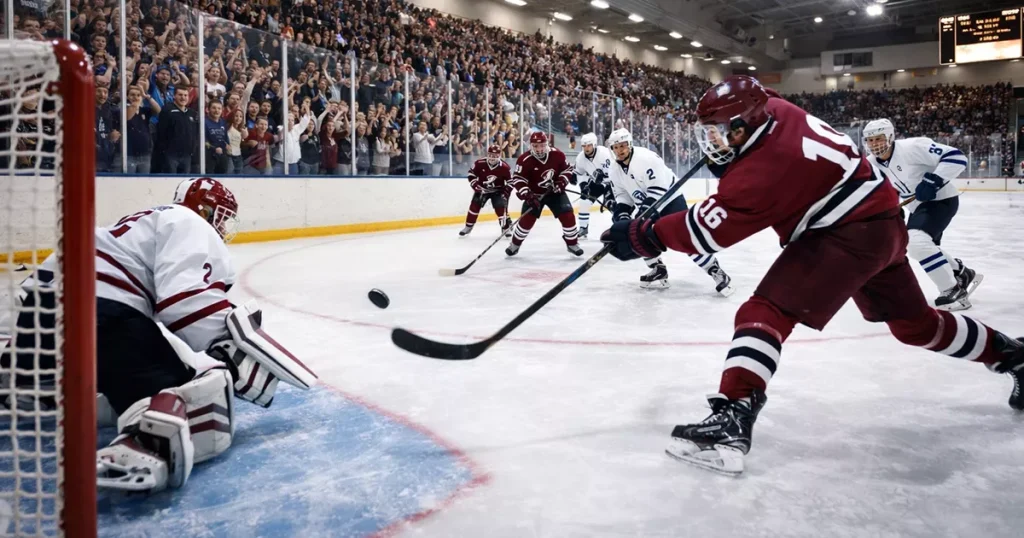
College hockey occupies a unique niche in the sports betting landscape. It is a sport played at a high level by future NHL stars, watched passionately by dedicated regional fan bases, and largely ignored by the broader betting public. That combination of quality play and low betting volume creates a market with genuine inefficiency, where the sportsbook’s lines are set with less precision and the edges available to informed bettors are wider than anything the NHL offers on a typical night.
NCAA Division I men’s ice hockey features 63 teams across six conferences, with a regular season running from October through March followed by conference tournaments and the NCAA Tournament, culminating in the Frozen Four. The season produces hundreds of games, most of which are available for betting at major sportsbooks, and the market’s relative obscurity means you are competing against fewer sharp bettors for every dollar of value on the board.
Unique Factors in College Hockey Betting
The most fundamental difference between college hockey and the professional game is roster turnover. NHL teams retain their core players for years. College teams lose players constantly to graduation, early departure to professional leagues, and the transfer portal. A team that reached the Frozen Four in April may lose its top three scorers and starting goaltender by September. This annual roster churn makes preseason projections far more uncertain than in the NHL, and it means that early-season results carry outsized importance for recalibrating expectations.
The age and developmental stage of the players also matters. College hockey players are 18-24 years old, which means their performance trajectories are steep and unpredictable. A freshman who looked average in October can become a dominant force by January as he adjusts to the speed and physicality of the college game. A senior who was reliable for three years can suddenly decline as age-peers who were more talented moved on to pro hockey. This developmental volatility makes individual player projections less reliable and team-level metrics more important.
The style of play in college hockey tends to be more structured and coach-dependent than in the NHL. College coaches have more control over their players’ systems because the players are younger, more coachable, and less likely to freelance. A well-coached college team will execute its forechecking, breakout, and power play systems with discipline, and that systemic consistency can mask individual talent deficiencies. For bettors, this means coaching quality and tactical identity are more predictive in college hockey than in the NHL, where individual talent often overrides system play.
Special teams are disproportionately important in college hockey. Penalty rates are higher at the college level because younger players take more undisciplined penalties, and the power play conversion rates vary wildly between teams. A college team with an elite power play facing an opponent that takes frequent penalties has a structural advantage that can dominate the game, and these mismatches are more extreme than what you see in the NHL.
The Home Arena Advantage
Home ice advantage in college hockey is significantly larger than in the NHL. College arenas range from intimate 3,000-seat buildings with student sections pressed against the glass to larger venues that hold 10,000 or more. The atmosphere in the best college hockey arenas is among the most intense in all of sports, and the visiting team faces a hostility that professional athletes, accustomed to road environments, rarely experience at the same level.
The data supports a substantial home advantage. Home teams in NCAA Division I hockey win approximately 57-60% of games, depending on the conference and the season. That is several percentage points above the NHL’s home winning rate, and the difference is large enough to have meaningful betting implications. The market adjusts for home ice, but the adjustment is not always sufficient, particularly for teams whose home arena produces an outsized advantage.
Regional travel patterns amplify the home effect. Many college hockey conferences are geographically concentrated, with teams in the same state or neighboring states. Weekend road series, where a team plays Friday and Saturday at the same opponent’s arena, are common in college hockey. The team traveling for a two-game weekend series faces the full weight of the opponent’s home advantage for two consecutive nights, and the fatigue of back-to-back games in a hostile environment compounds the disadvantage.
Certain programs have built reputations as nearly unbeatable at home. These programs combine a passionate fan base with a difficult-to-reach location, cold weather that discourages casual attendance from visiting fans, and a rink configuration that maximizes crowd noise. Betting against these teams at home requires a compelling reason, and the line often does not provide one because the sportsbook has already priced in a significant home edge.
The Frozen Four and NCAA Tournament Betting
The NCAA Tournament is where college hockey betting reaches its widest audience. The tournament features sixteen teams in a single-elimination format, and it draws betting interest from casual fans who may not have watched a college hockey game all season. That influx of uninformed money creates opportunities for bettors who have followed the sport closely.
Single-elimination hockey, as in international tournaments, maximizes variance. A team with a hot goaltender can knock off a top seed in a single game, and the upset rate in the NCAA Tournament is higher than casual fans expect. The tournament committee seeds teams based on regular-season and conference tournament performance, but the seedings do not always align with underlying quality metrics. A team that earned a high seed through an easy conference schedule may be less prepared for the tournament than a lower-seeded team from a brutal conference that spent the entire season playing against high-caliber opponents.
Goaltending is the decisive factor in the Frozen Four. College goaltenders are more variable than NHL goaltenders because they are younger, less experienced, and more susceptible to the pressure of a high-stakes environment. A freshman goaltender making his first tournament start is a fundamentally different proposition than a senior who has played in three previous tournaments. Experience and composure under pressure are qualitative factors that the statistics do not always capture but that manifest clearly on the ice when the stakes rise.
The neutral site factor also affects Frozen Four betting. The Frozen Four is played at a predetermined neutral venue, which eliminates the home ice advantage that some teams relied on throughout the season. Teams that were dominant at home but mediocre on the road face a structural disadvantage at the Frozen Four because the environment is closer to a road game than a home game. Conversely, teams with strong road records and the ability to perform in hostile environments are better suited to the neutral site format.
Information Edges in College Hockey
The information gap between college hockey and the NHL is enormous, and that gap is your primary edge. NHL games are covered by dozens of beat reporters, analyzed by public analytics platforms, and discussed on every sports media outlet in North America. College hockey games are covered by a handful of local journalists, occasionally mentioned by regional sports networks, and largely ignored by the national media outside of the Frozen Four.
This information vacuum means that significant developments — a starting goaltender injury, a suspension of a key player, a coaching change in mid-season — may not reach the sportsbook’s line-setters as quickly or accurately as equivalent NHL news would. The bettor who follows college hockey beat writers, monitors team social media accounts, and reads game recaps from local outlets holds information that the market has not yet absorbed.
Roster knowledge is particularly valuable. Knowing which freshmen are earning increased ice time, which line combinations coaches are experimenting with, and which players are returning from injury provides a granular understanding of team composition that the sportsbook’s model, which likely relies on broader team-level metrics, cannot match. A team that gets its best scorer back from a three-week injury absence might see minimal line movement because the sportsbook was not tracking the injury closely. The bettor who knows the player is back can capture value before the market adjusts.
Conference familiarity is another edge. Bettors who specialize in a single conference — following every team, watching games regularly, and building intuitive and analytical models based on repeated observation — develop a depth of understanding that no generalist model can replicate. The Big Ten, Hockey East, NCHC, and ECAC each have their own competitive dynamics, playing styles, and officiating tendencies, and the bettor who knows a conference inside and out can evaluate its teams with a precision that the broad market simply does not invest in.
The Overlooked Market
College hockey will never generate the betting volume or media attention of the NHL, and that is precisely why it remains one of the most attractive hockey betting markets available. The inefficiency is structural. The information gap is real. The home ice advantages are large and sometimes underpriced. And the annual roster turnover ensures that the market must continually recalibrate, which creates fresh opportunities every season.
The bettor who treats college hockey as a serious analytical endeavor rather than a side entertainment finds a market that rewards effort in direct proportion to the work invested. The lines are waiting, the games are competitive, and the number of people doing the homework is small enough that your homework actually matters.
